

The Fed Has Turned Policy Surprise Into a Managed Variable

The Fed Has Turned Policy Surprise Into a Managed Variable
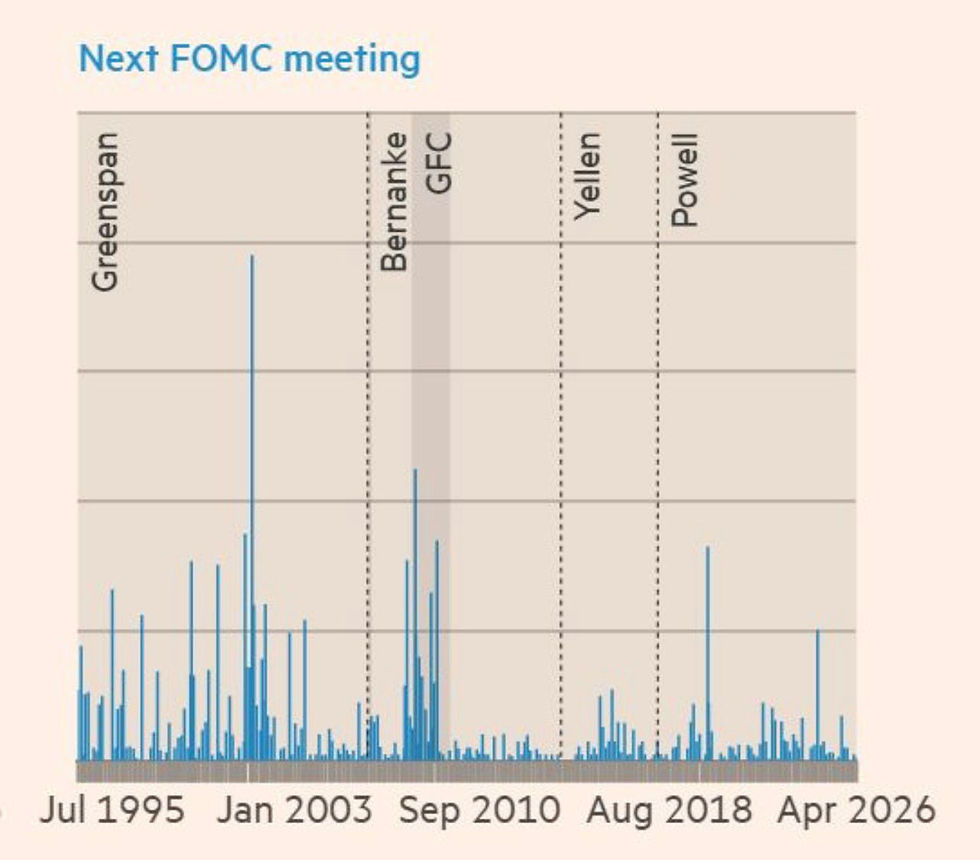

The chart captures one of the most important institutional changes in modern macro-finance: the Federal Reserve has shifted from a central bank that often surprised markets with the policy decision itself to a central bank that tries to move market expectations before the decision arrives. The visible result is a decline in measured monetary policy surprises around Federal Open Market Committee meetings. Before the transparency reforms associated with Ben Bernanke, especially the post-crisis adoption of clearer forward guidance, regular press conferences, and more explicit policy signaling, markets often experienced unexpectedly large moves in expected policy rates for both the current and subsequent meetings. Under Alan Greenspan and the early Bernanke years, surprises of 20 to 45 basis points were not extraordinary. Under Janet Yellen and Jerome Powell, the surprise distribution became more compressed.
That change is not cosmetic. It affects how monetary policy is transmitted to asset prices, credit conditions, risk appetite, and the real economy. A modern central bank does not merely set an overnight rate. It manages a path of expected future rates, balance-sheet expectations, inflation credibility, and financial conditions. In that framework, communication is not public relations. Communication is an instrument of policy. When the Fed guides expectations well, part of the tightening or easing occurs before the official decision. When the decision finally arrives, it should ideally confirm a distribution that markets have already internalized rather than shock them into abrupt repricing.
The source chart’s thesis is therefore deeper than “the Fed became more transparent.” The deeper point is that policy surprise itself has become a managed variable. The central bank has learned that unnecessary uncertainty can create volatility without improving macroeconomic outcomes. If the Fed already knows its reaction function, and if the economy is evolving broadly as expected, it can often make policy more effective by explaining its reaction function in advance. The market then adjusts financial conditions gradually. Borrowers, lenders, equity investors, and households receive a clearer signal. The cost of adjustment is spread over time rather than concentrated at a single meeting.
This is a major reason the post-crisis communication regime matters for investors. Policy surprises are not just event-study curiosities. They shape discount rates, curve expectations, the dollar, credit spreads, equity volatility, and portfolio leverage. A 25-basis-point surprise can have a much larger effect than a 25-basis-point expected move because it forces investors to revise not only the current policy rate, but also the central bank’s information set and reaction function. A surprise says: the Fed knows something, believes something, or intends something different from what the market thought. That is why surprises command attention.
At the same time, a world with fewer meeting-day surprises is not a world without uncertainty. It is a world where uncertainty migrates. Some uncertainty moves from the meeting date to the weeks before the meeting, when officials speak, data arrive, and investors infer the reaction function. Some uncertainty moves from the current decision to the terminal rate, the timing of cuts, the neutral rate, and the balance sheet. Some uncertainty moves from discrete decisions to macro data releases. The Fed can reduce unnecessary policy surprise, but it cannot eliminate fundamental uncertainty about inflation, employment, productivity, fiscal policy, financial stability, and global shocks.
From Deliberate Opacity to Conditional Transparency
For much of the twentieth century, central banking was deliberately opaque. The old style reflected a belief that policy effectiveness partly depended on discretion and mystique. Markets were expected to infer the stance of policy from open-market operations, reserve conditions, and the behavior of short rates. The Fed did not always announce policy decisions immediately, and it certainly did not offer the kind of regular explanatory architecture that modern investors now take for granted. In that world, policy surprises were not merely accidents. They were partly a byproduct of an institutional culture that placed less value on public signaling.
The Greenspan era began to change that, but only gradually. Greenspan was often viewed as a master of strategic ambiguity. Markets listened intensely to his language, but the communication style was indirect, sometimes intentionally complex, and not always designed to pin down a clear policy path. The Fed became more communicative over time, but it had not yet fully adopted the modern architecture of explicit forward guidance, published projections, regular press conferences after every meeting, and systematic discussion of reaction functions. As a result, markets still faced larger uncertainty around both the immediate decision and the expected path beyond it.
The Bernanke period marked a decisive intellectual shift. Bernanke came from an academic tradition that treated expectations as central to monetary transmission. New Keynesian models emphasize that current spending and asset prices depend not only on the current policy rate, but also on expected future real rates. If a central bank can shape expected future rates, it can influence financial conditions even when the current short rate is constrained. That insight became crucial after the Global Financial Crisis, when the zero lower bound made ordinary rate cuts insufficient. Forward guidance and asset purchases became tools for managing expectations directly.
Regular press conferences and clearer policy signaling were part of the same transformation. A press conference gives the chair an opportunity to explain the decision, qualify the statement, answer questions about the reaction function, and reduce interpretive noise. It also creates risk, because every word can move markets. But the broader purpose is to reduce unnecessary ambiguity. If policymakers disagree, the market can learn the range of views. If the data are mixed, the chair can explain what matters most. If a policy path is conditional, the chair can define the conditions.
Yellen inherited and refined this transparency regime. Her communication style emphasized labor-market slack, inflation dynamics, and gradual normalization. Markets could still be surprised, but the framework was generally legible. Powell then pushed the regime through a radically different environment: pandemic shock, emergency easing, inflation surge, and rapid tightening. Even when Powell’s Fed delivered historically large hikes, many were heavily telegraphed. The surprise was often not the meeting-day action itself, but the speed at which the macro data forced the expected path to move between meetings.
This is the essential distinction. In the modern regime, the Fed still surprises markets, but it tries to avoid surprising them unnecessarily on the exact day of the decision. If inflation data are hotter than expected, if employment is stronger than expected, or if financial conditions loosen too much, markets may revise the path before the Fed acts. That is still monetary tightening. It simply occurs through expectations first and the formal decision later. The chart’s decline in meeting surprises is consistent with this broader shift.
What a Policy Surprise Actually Measures
A monetary policy surprise is usually measured by the change in market-implied rates in a narrow window around an FOMC announcement. Researchers often use federal funds futures, overnight index swaps, Eurodollar or SOFR futures, and Treasury yields to estimate how much of the decision was unexpected. The logic is simple: if markets expected a 25-basis-point hike and the Fed delivered 25 basis points with no change in guidance, the measured surprise should be small. If the Fed delivered 50 basis points, or if it signaled a much higher future path, market-implied rates should jump.
But policy surprises have multiple dimensions. There is a target-rate surprise, which concerns the immediate decision. There is a path surprise, which concerns expected future policy. There is a statement or guidance surprise, which concerns language about inflation, employment, risk balance, or future moves. There is also an information surprise: markets may infer that the central bank has a different assessment of the economy. A hawkish surprise can mean the Fed is more worried about inflation, but it can also mean the Fed sees the economy as stronger than private investors believed. The asset-price response depends on which interpretation dominates.
This is why the current-meeting and next-meeting surprises in the chart are both important. A surprise in the current meeting affects the front end of the curve directly. A surprise in the subsequent meeting affects the expected policy path. In modern monetary policy, the path can matter more than the current setting. A central bank that raises rates today but signals a pause may produce a different market reaction from a central bank that raises rates today and signals a long campaign. Investors care about the discounted sequence of future short rates, not only the current overnight rate.
The path dimension also explains why forward guidance can be powerful. If the Fed credibly signals that policy will remain restrictive until inflation is clearly moving down, longer maturity yields, credit spreads, equity multiples, and the dollar can adjust before additional hikes occur. Conversely, if the Fed credibly signals that it is nearing the end of tightening, risk assets may rally even before cuts begin. In both cases, communication shifts financial conditions through expectations. That is exactly why the modern Fed spends so much effort on language.
A smaller surprise distribution therefore suggests that the market and central bank are communicating more effectively. It does not mean the Fed has become easier or more dovish. It means the market has a better prior about the Fed’s reaction function. If the data come in as expected, the meeting outcome should also come in close to expected. That reduces abrupt repricing. It also means that data releases and Fed speeches become part of the policy process. The surprise is distributed over time rather than concentrated in one announcement.
There is a useful analogy to corporate earnings. A company that gives credible guidance and updates investors regularly may still report strong or weak results, but the earnings-day surprise tends to be smaller if the market understands the business trajectory. A company that provides little guidance may create larger event risk. The Fed is not a corporation, and policy is not earnings, but the information structure is similar. Transparent guidance can reduce event risk, while opaque guidance can concentrate it.
Why Transparency Became a Policy Tool
Transparency became more valuable because monetary policy increasingly operates through expectations. In a simple textbook model, the central bank changes the short rate, banks adjust lending rates, and the economy responds. In modern capital markets, the mechanism is broader. Mortgage rates, corporate bond yields, equity multiples, exchange rates, bank stock prices, volatility, and private credit conditions respond to expected policy paths. If the Fed can influence those expectations, it can influence the economy before the mechanical banking channel has fully transmitted the policy rate.
The zero lower bound made this unavoidable. After the Global Financial Crisis, the Fed could not cut the policy rate much below zero, yet the economy still needed support. Forward guidance allowed the Fed to promise, conditionally or explicitly, that rates would remain low for a long period. Quantitative easing worked partly through portfolio balance effects, but also through signaling: large asset purchases communicated a commitment to accommodation. In that setting, communication was not secondary. It was part of the stimulus.
The inflation surge after the pandemic showed the other side of the same tool. When inflation became persistent, the Fed needed to tighten financial conditions rapidly. Some of that tightening occurred through actual hikes, but much of it occurred through repricing the expected path. Markets pulled forward hikes before each meeting. Mortgage rates rose before the policy rate reached its peak. Equity valuations adjusted as real yields rose. Credit conditions tightened as investors recognized that the Fed would prioritize inflation control. In other words, communication helped transmit tightening as well as easing.
The key benefit is smoother adjustment. Abrupt policy surprises can destabilize risk management. Leveraged investors may be forced to delever quickly. Duration hedges can break. Liquidity can disappear. Banks and corporate treasurers may face sudden funding-cost changes. If the same policy path can be communicated gradually, the real economy may adjust with less financial stress. The central bank still changes the stance of policy, but it reduces avoidable discontinuities.
Transparency also supports accountability. A central bank with enormous power should explain what it is doing and why. Clear communication allows elected officials, investors, businesses, and households to evaluate whether policy is consistent with the mandate. It also disciplines the central bank internally. If officials have to explain the reaction function, they must think more clearly about it. Published projections, press conferences, and minutes create a record that can be assessed later.
Yet transparency is not costless. If communication becomes too precise, the market may treat conditional guidance as a promise. If the data change and the Fed changes course, investors may accuse it of inconsistency. If officials speak too often, the signal can become noisy. If the chair tries too hard to avoid volatility, markets may infer a policy put and take more risk. The art is to be clear about the reaction function without pretending to know the future.
A Deeper Look at the Transmission Chain
The compression of policy surprises matters because the transmission chain of monetary policy has become more market-based. In a bank-dominated system, the central bank could focus more narrowly on the cost and availability of bank credit. In a market-based system, the transmission channel includes bond mutual funds, pension allocations, hedge-fund leverage, private credit marks, mortgage-backed securities, derivatives, exchange rates, and the equity cost of capital. The central bank’s words enter this system immediately. A sentence that changes the expected policy path can alter the discount rate used by an equity analyst, the hedge ratio used by a mortgage investor, the funding spread faced by a leveraged borrower, and the currency assumption used by a multinational firm.
This creates a feedback loop. The Fed communicates, markets move, and those market moves become part of financial conditions. If equities rally too strongly after a dovish interpretation, financial conditions may loosen in a way that complicates the inflation fight. The Fed may then respond with more hawkish communication. If credit spreads widen too abruptly after a hawkish signal, the Fed may clarify that policy is restrictive but not mechanically precommitted. Communication and market pricing become an iterative game. The lower meeting-day surprise is partly the result of that game being played continuously before the meeting.
The expectations channel is especially visible in mortgage markets. Mortgage rates are priced off longer-term yields and mortgage-backed securities spreads, not directly off the current federal funds rate. If the Fed persuades markets that rates will stay high for longer, mortgage rates can rise immediately, cooling housing demand before additional policy actions occur. If the Fed persuades markets that cuts are approaching, mortgage rates can fall before the first cut. This is policy transmission through expectations. It is also why the Fed watches financial conditions after it communicates. The market reaction is not a side effect; it is part of the mechanism.
A similar logic applies to corporate finance. A treasurer deciding whether to issue debt, refinance, repurchase shares, or delay investment cares about the expected path of rates and spreads. Clear Fed communication can pull those decisions forward. If firms believe financing costs will rise, they may issue earlier. If they believe policy easing is coming, they may wait. These micro decisions aggregate into credit growth, capital spending, and eventually employment. A meeting-day surprise is only the visible tip of a much larger expectations structure.
The academic literature on monetary policy shocks helps clarify why this matters. Kuttner-style futures-based surprise measures, high-frequency identification around FOMC windows, and later work separating target and path factors all show that markets respond differently to immediate policy surprises and future-path surprises. The modern communication regime is essentially an attempt to manage the path factor more deliberately. It does not remove shocks, but it changes where shocks appear and how quickly they propagate.
This also explains why transparency can make monetary policy more powerful even when surprises are smaller. If a central bank can move the entire expected path with credible communication, it may not need to surprise markets at the meeting. The absence of surprise is not weakness. It can be evidence that policy has already worked through the curve. By the time the vote occurs, financial conditions may have adjusted enough that the formal decision merely validates the move.
Asset Pricing in a Lower-Surprise Regime
For equities, lower meeting-day policy surprise tends to reduce one form of event risk. If investors can forecast the current decision more accurately, they face less need to demand an event premium around every FOMC date. That can support lower implied volatility, tighter risk premia, and more stable positioning. But the effect is conditional. If the expected policy path is restrictive, equities can still suffer even if there is no surprise. A fully expected tightening cycle is still tightening.
This distinction is crucial. Markets often rally when the Fed “does what was expected,” but that relief rally should not be confused with a change in fundamentals. If the expected path remains high enough to slow growth, compress multiples, or weaken credit, the absence of surprise only removes one risk. It does not remove the macro effect of policy. A lower-surprise regime changes the timing and volatility of repricing, not necessarily the direction.
For bonds, the decline in surprise changes the distribution of front-end volatility. The front end of the yield curve is highly sensitive to expected policy rates. If meeting outcomes are better anticipated, some front-end volatility migrates to data releases: CPI, payrolls, retail sales, employment cost index, and inflation expectations surveys. Traders may focus less on the meeting and more on the data path that determines the meeting. This is exactly what has happened in recent cycles. The FOMC date matters, but the CPI print can matter more.
For credit, transparency can be stabilizing if it reduces policy shocks. Credit spreads dislike abrupt uncertainty because default-risk pricing is nonlinear. A surprise tightening can widen spreads quickly, especially when leverage is high and liquidity is thin. But gradual guidance allows issuers and investors to adapt. Companies can term out debt, hedge exposure, or delay issuance. Investors can adjust duration and credit beta. Again, the benefit is not that policy is easier; it is that the adjustment path is more legible.
For the dollar, policy path surprises are often more important than the current rate move. A hawkish path surprise can lift the dollar because it raises expected U.S. real rates relative to other economies. A dovish surprise can weaken it. If the Fed communicates clearly, some of that currency adjustment occurs before the decision. This can be especially important for global risk assets, emerging markets, and commodities, because dollar strength affects funding conditions and trade prices.
For portfolio construction, the lower-surprise regime changes event-risk management. Investors still need to manage FOMC risk, but they also need to manage pre-FOMC communication risk and data-release risk. The relevant question becomes: where is the market learning? If the market is learning mostly from the statement, then the meeting is the event. If it is learning mostly from inflation data and Fed speeches, then the meeting may be confirmation. A sophisticated process maps the calendar of information, not just the calendar of decisions.
Global Spillovers and the Yield-Curve Interpretation
The Fed’s communication regime matters beyond the United States because the dollar funding system is global. When the Fed surprises markets, the shock does not remain inside the federal funds market. It moves through dollar funding costs, cross-currency basis, emerging-market exchange rates, commodity prices, and global risk appetite. A more predictable Fed can therefore reduce unnecessary global spillovers. This does not mean U.S. policy becomes painless for the rest of the world. If the Fed must tighten because U.S. inflation is too high, global dollar conditions may still tighten. But a well-telegraphed tightening path gives foreign central banks, sovereign issuers, corporates, and investors more time to adjust.
This is particularly important for emerging markets. Many emerging-market borrowers have direct or indirect exposure to dollar funding. A surprise hawkish move can strengthen the dollar, raise local risk premia, and force domestic central banks to respond even if local conditions are weak. Clearer Fed communication can reduce the sudden-stop component of that shock. It allows local policymakers to prepare reserves, guide domestic expectations, and decide whether to follow the Fed or tolerate currency adjustment. Again, transparency does not remove the global constraint created by the dollar system, but it can reduce avoidable discontinuity.
The yield curve also becomes easier to interpret when policy surprises are decomposed. The front end reflects expected policy over the next several meetings. The belly reflects the expected cycle path, including the peak rate and the timing of future cuts. The long end reflects expected short rates, term premium, inflation uncertainty, fiscal supply, and global duration demand. A communication shock can affect each segment differently. A surprise about the next meeting may move two-year yields sharply. A surprise about inflation credibility or balance-sheet policy may move the ten-year yield through term premium. Investors should therefore ask which part of the curve is reacting to Fed communication.
In a transparent regime, curve moves before the meeting often contain the policy message. If two-year yields rise steadily after a sequence of strong inflation prints and hawkish speeches, then a later rate hike may produce little additional surprise. If the curve steepens because markets believe the Fed will tolerate higher inflation or because fiscal term premium is rising, the implications are different from a front-end repricing driven by near-term hikes. The curve is not a single price. It is a map of expected policy, inflation compensation, and risk premia.
This is why investors should avoid treating “Fed surprise” as one number. A small current-meeting surprise can coexist with a large path repricing over the prior month. A large statement surprise can occur even if the target rate is unchanged. A dovish press conference can offset a hawkish dot plot, or a hawkish inflation forecast can offset a dovish current decision. The market reaction is the net result of these layers. The chart’s decline in measured surprises is a useful summary, but the investment work requires unpacking the components.
The same logic applies to equities by sector. Banks may respond to curve slope and credit risk. Technology may respond more to real yields and long-duration discounting. Homebuilders may respond to mortgage rates. Multinationals may respond to the dollar. Utilities may respond to bond-proxy valuation. A lower-surprise Fed does not create one uniform equity implication. It changes how each sector receives policy information. The broad index may appear calm while major rotations occur underneath.
For long-horizon asset allocators, the global and curve dimensions reinforce the main lesson: the Fed’s words are part of the pricing mechanism. A modern macro portfolio cannot separate policy decisions from policy communication, or domestic rates from global dollar conditions. The decline in surprise is not merely a U.S. institutional story. It is part of the architecture through which the world’s most important central bank transmits information into global asset prices.
The final practical point is that investors should measure communication risk over the whole intermeeting period. A quiet FOMC day can still be preceded by a violent repricing in futures, mortgage rates, the dollar, and equities. If that repricing was caused by data and validated by Fed speakers, then policy transmission has already occurred. In that sense, the modern Fed often tightens or eases before it formally tightens or eases. The meeting is the legal act; the expectation shift is the market act.
The New Risks Created by Guidance
Forward guidance reduces one kind of uncertainty but can create another: commitment risk. If the Fed communicates a likely path too strongly, it may become psychologically or reputationally attached to that path. When the data shift, the central bank must decide whether to preserve the guidance or preserve macro flexibility. Good guidance is conditional. Bad guidance becomes a trap. Investors should therefore listen not only to what the Fed expects, but also to how explicitly the Fed describes the conditions that would change its mind.
Another risk is market overfitting. When policy communication becomes frequent, investors can become obsessed with small wording changes. A single adjective can move yields. A phrase removed from a statement can become a trading catalyst. This creates a strange paradox: more communication can reduce large surprises while increasing micro-volatility around language. The market may become better informed about the reaction function, but more sensitive to tiny perceived shifts.
There is also the risk of false precision. Economic forecasting is hard, and central banks do not know the future. Dot plots and projections are useful, but they can appear more precise than they really are. A median dot is not a commitment. It is a conditional forecast from individual policymakers. If investors treat it as a promise, they may build positions that are vulnerable to data revisions. The Fed has repeatedly had to remind markets that projections are not plans.
Transparency can also encourage moral hazard if investors believe the Fed will always communicate enough to prevent disorderly adjustment. The so-called central bank put is not only about rate cuts. It is also about the belief that officials will step in verbally when markets fall too quickly. If that belief becomes too strong, risk-taking can increase, valuations can stretch, and the eventual adjustment can be larger. A central bank that reduces volatility too aggressively may unintentionally store volatility for later.
Finally, guidance can be complicated by committee diversity. The FOMC is not one mind. It includes governors and regional presidents with different models, mandates, and local information. Transparency means those differences become visible. That is healthy for accountability, but it can confuse markets if the committee speaks with too many voices. The chair’s job is therefore not merely to state personal views. The chair must synthesize the committee’s reaction function into a coherent signal.
These risks do not invalidate transparency. They define its frontier. The goal is not maximum communication. The goal is useful communication. The Fed should explain its reaction function, uncertainty, and conditionality without pretending to eliminate uncertainty. Investors should welcome smaller unnecessary surprises while remembering that the economy itself remains uncertain.
The Bernanke-Yellen-Powell Legacy
Bernanke’s communication legacy is often described in terms of press conferences and forward guidance, but its deeper contribution was intellectual. It made expectations management explicit. In crisis conditions, that mattered enormously. The Fed needed to convince markets that policy would remain accommodative long enough to support recovery. It also needed to explain unconventional tools that were unfamiliar to many investors. Clearer communication helped create a bridge between policy innovation and market understanding.
Yellen’s legacy was gradualism and labor-market nuance. Her Fed communicated normalization as a slow and conditional process. That reduced the chance of unnecessary shocks as the economy healed. Markets did not always agree with the Fed’s inflation assessment, but the broad framework was understandable: the Fed saw slack diminishing, expected inflation to move toward target, and wanted to remove accommodation gradually. The communication regime helped make that path digestible.
Powell’s legacy is more complex because he has presided over both extraordinary easing and extraordinary tightening. Early in the pandemic, communication had to stabilize markets and reassure investors that liquidity would be provided. Later, as inflation surged, communication had to convince markets that the Fed would tighten even at the cost of slower growth. The transition was not perfectly smooth. The “transitory” inflation episode damaged credibility. But once the Fed pivoted, the tightening path was heavily communicated, and many large hikes arrived with limited meeting-day surprise because markets had already repriced.
This sequence shows both the strength and weakness of modern transparency. When the Fed’s diagnosis is right, communication can make policy more effective and less disruptive. When the diagnosis is wrong, communication can amplify the wrong message. If the Fed tells markets inflation is temporary and later discovers it is not, the eventual correction must be larger. Transparency does not guarantee accuracy. It magnifies the importance of accurate analysis.
For investors, the lesson is to separate communication quality from forecast quality. The Fed can communicate clearly and still be wrong. It can also communicate poorly while having a defensible policy stance. The best environment is clear communication plus a correct reaction function. The worst is confident communication around a mistaken forecast. The chart’s lower surprise regime should therefore be read as evidence of better signaling, not as proof of perfect policy.
The current environment continues to test this legacy. Inflation dynamics, fiscal deficits, supply chains, technology investment, immigration, labor-market rebalancing, and financial stability all complicate the policy outlook. The Fed can guide expectations, but it cannot know every shock. The value of transparency is that it helps markets understand how the Fed will respond as shocks arrive. The value is not that it makes shocks disappear.
How Investors Should Use This Information
The first practical implication is to distinguish expected policy from surprise policy. An expected hike, expected hold, or expected cut is largely already embedded in prices. The market impact depends on what changes relative to expectations. Investors should therefore track not only the policy decision, but also futures pricing, OIS curves, survey expectations, and the distribution of analyst forecasts. The surprise is the gap between outcome and expectation.
The second implication is to separate target surprises from path surprises. A meeting can deliver the expected current rate but still surprise through the statement, projections, or press conference. Conversely, a current-rate surprise can be softened if guidance offsets it. For asset allocation, the path usually matters more. Long-duration equities, the dollar, credit spreads, and the yield curve respond to the expected sequence of future real rates.
The third implication is that data releases have become quasi-policy events. If the Fed has made its reaction function clear, then inflation and labor-market data mechanically update expected policy. CPI day, payrolls day, and employment-cost data can move markets as much as, or more than, FOMC day. A calendar that treats only central-bank meetings as macro events is outdated. The information chain now runs from data to Fed communication to market pricing to formal policy.
The fourth implication is to monitor credibility. A transparent central bank with credibility can guide markets with fewer abrupt moves. A transparent central bank without credibility may have to deliver larger actions to be believed. Credibility is observed in inflation expectations, term premium, market reaction to speeches, and the alignment between Fed guidance and market pricing. When credibility is high, words can do more work. When credibility is low, actions must do more work.
The fifth implication is to avoid complacency around low surprise. A low-surprise FOMC calendar can invite leverage because event risk appears contained. But if uncertainty has migrated to macro data, positioning can still be vulnerable. The absence of meeting-day shocks does not mean the absence of macro shocks. It means the shock may arrive through CPI, payrolls, oil prices, fiscal news, or credit stress.
The final implication is to treat Fed communication as a state variable. Investors should not merely ask whether the Fed is hawkish or dovish. They should ask whether the reaction function is stable, whether guidance is conditional, whether the committee is coherent, whether markets believe the message, and whether the data are validating the message. Those questions are more useful than parsing one sentence in isolation.
The Boundary Between Predictability and Optionality
The hardest problem for the Fed is preserving optionality while being predictable. Markets want a clear path, but the economy rarely gives policymakers a clear path. Inflation can look contained and then reaccelerate. Labor markets can appear too tight and then loosen quickly. Financial stability can look robust until a funding market breaks. If the Fed gives too little guidance, investors face unnecessary uncertainty. If it gives too much, the Fed may lose flexibility. The modern communication regime is therefore a balancing act between predictability and optionality.
Conditional language is the main solution. Phrases such as “data dependent,” “higher for longer if needed,” or “confidence that inflation is moving sustainably toward target” can sound repetitive, but they serve an important function. They tell markets that the policy path is linked to observable outcomes. The best guidance is not a calendar promise. It is a map from states of the world to likely policy responses. Investors should therefore evaluate whether Fed communication gives a clear state-contingent map, not whether it gives a fixed date for the next move.
There is also a difference between reducing surprise and suppressing volatility. Reducing surprise means making the reaction function understandable. Suppressing volatility means trying to prevent markets from moving. The first is healthy. The second can be dangerous. Markets should move when the economic outlook changes. If inflation risk rises, yields should rise. If recession risk rises, risk assets should reprice. A transparent Fed should not prevent price discovery. It should prevent avoidable confusion about policy.
This boundary matters because the Fed’s credibility is partly built by tolerating market moves that are consistent with its goals. If financial conditions need to tighten to bring inflation down, the Fed cannot always rescue equities from falling multiples. If credit spreads widen because default risk is genuinely rising, the Fed must distinguish between healthy repricing and systemic dysfunction. Communication should clarify that distinction. The market should not expect every unpleasant repricing to be neutralized.
For long-term investors, this means a predictable Fed is not the same as a friendly Fed. Predictability helps investors understand the rules of the game. It does not guarantee that the rules will favor risk assets. A clearly communicated tightening campaign can still be painful. A clearly communicated easing cycle can still occur during recession. The value of predictability is that it reduces unnecessary noise, not that it removes the cycle.
The chart’s message is strongest when read this way. The Fed has become better at communicating the rules, but the game itself remains difficult. Investors who understand the distinction can use Fed communication as a framework rather than a trading slogan. They can ask how each new data point changes the state-contingent policy map. That is more powerful than asking whether the next meeting will surprise by 25 basis points.
Conclusion
The decline in monetary policy surprises across recent Fed regimes is a structural development in macro-finance. It reflects a central bank that has learned to use communication as a policy instrument. The Fed now tries to shape expectations before meetings rather than rely on meeting-day shocks. Forward guidance, press conferences, projections, and clearer signaling have made policy more predictable and often less disruptive. That is why large surprises that were more common in the Greenspan and early Bernanke years became less frequent under Yellen and Powell.
But the achievement should be interpreted carefully. Smaller policy surprises do not mean monetary policy is less powerful. They mean more of the policy impulse is transmitted through expectations before the official decision. They do not mean uncertainty is gone. They mean uncertainty has moved toward macro data, the expected path, the terminal rate, the neutral rate, and the credibility of the reaction function. They do not mean the Fed is always right. They mean the Fed is more explicit about how it thinks.
For markets, this is both stabilizing and challenging. It reduces unnecessary volatility around the meeting itself, but it requires investors to understand the full information ecosystem. The modern policy event is not just the FOMC announcement. It is the sequence of inflation data, labor data, speeches, minutes, projections, press conferences, and market pricing that surrounds the announcement. The decision is often the final confirmation of a process already underway.
The practical lesson is direct: policy surprise has become a managed variable, but macro surprise has not disappeared. Investors should welcome the decline in unnecessary meeting shocks while remaining alert to the places where uncertainty now lives. The Fed can guide expectations, but it cannot repeal the business cycle, forecast every inflation shock, or eliminate the risk that its own framework proves incomplete. Transparency is a powerful tool. It is not omniscience. The chart matters because it shows how far central banking has moved from opacity toward expectation management, and because it reminds investors that in modern markets, words can tighten or ease financial conditions long before the vote is recorded.


Comments