

The Labor Market Is Resilient, but the Jobs Engine Has Changed
- Lingxiao Xu
- Jul 3
- 18 min read

The Labor Market Is Resilient, but the Jobs Engine Has Changed
The June employment report looked reassuring on the surface. Nonfarm payrolls increased by 147,000, above expectations, and the unemployment rate edged down to 4.1%. In the narrow cyclical language that usually surrounds payroll Fridays, those are not recessionary numbers. They suggest that firms are still hiring, household income is still being supported, and the economy has not yet tipped into the broad labor-market deterioration that usually forces an abrupt turn in monetary policy.
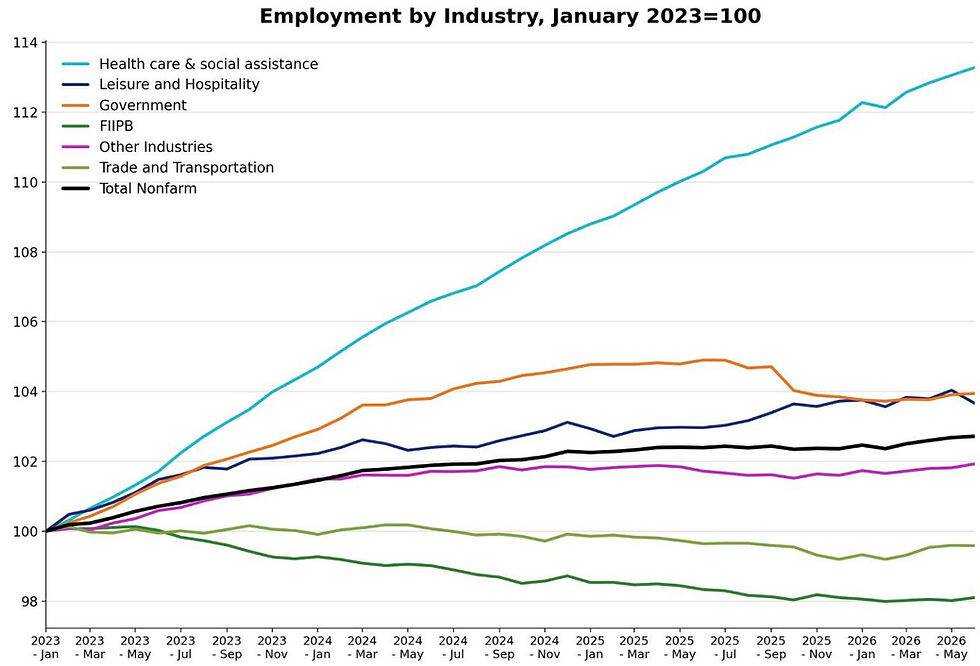
But the more important message is not the headline payroll number. It is the composition of hiring. The chart, indexed to January 2023, shows a labor market that is still expanding in aggregate while its internal growth engine has become much narrower. Health care and social assistance have moved far above every other major sector. Government employment and leisure and hospitality have contributed meaningfully, though with different dynamics. Total nonfarm employment has continued to rise. Yet information employment remains well below its early-2023 level, and finance, insurance, and related professional categories have not participated in the same way. The economy is adding jobs, but not in the places that defined the prior expansion.
That distinction matters for investors because payroll resilience and payroll quality are different things. A resilient labor market can keep consumption alive and reduce near-term recession risk. A deteriorating employment mix can still point to slower productivity diffusion, weaker high-wage income growth, tighter corporate cost discipline, and a different sector map for equity earnings. The June report therefore gives two signals at once: cyclical resilience at the macro level, and structural reallocation beneath the surface.
The source text highlights the key facts. Professional and business services have added roughly 135,000 jobs over the past six months, helped by a recovery in temporary-help employment. That is important because temporary help has long been treated as a leading indicator of hiring sentiment. Firms usually add temp workers before making full-time commitments, and they often cut temp workers before cutting core staff. Meanwhile, information employment remains roughly 9% below its January 2023 peak, and finance and insurance employment has begun to decline despite continued economic expansion. Those are not classic early-cycle weakness patterns. They look more like the labor-market footprint of automation, AI adoption, organizational flattening, and productivity pressure.
Health care and social assistance, by contrast, continue to dominate job creation. That strength is not surprising, but it is consequential. Demographics, chronic disease management, long-term care needs, behavioral health demand, and institutional labor intensity all support hiring in that sector. The result is a labor market where the most durable job growth comes from areas tied to population aging and service needs, while the most scalable digital and financial sectors are learning to produce more with fewer people.
A Good Payroll Number Can Hide a Narrowing Expansion
The first temptation after a stronger-than-expected payroll report is to treat the labor market as broadly healthy. That is too simple. Payrolls are a diffusion problem, not only a level problem. If 147,000 jobs are added, the macro effect depends on where those jobs appear, what wages they carry, how cyclical they are, and whether the hiring reflects demand expansion or institutional necessity.
A job gained in health care does not have the same macro signal as a job gained in software, securities intermediation, manufacturing, or temporary help. Health care employment is often less sensitive to the business cycle because people need care regardless of GDP momentum. Government employment can reflect budget decisions and post-pandemic normalization rather than private-sector risk appetite. Leisure and hospitality hiring can reflect normalization in services demand, but it is often lower wage and more sensitive to discretionary spending. Professional services hiring, especially temporary help, says more about whether firms are preparing for broader growth.
That is why the temporary-help recovery is one of the more useful details in the report. The professional and business services category had been a source of concern because temp-help employment weakened sharply through much of the post-pandemic adjustment. Historically, the sector tends to roll over before the broader labor market. The fact that professional and business services have added about 135,000 jobs over six months, with temp help recovering, argues against an imminent, broad-based hiring freeze.
But this is not the same as saying the old high-wage growth engine has returned. The information sector remains far below its January 2023 employment level. Finance and insurance are softening. The chart shows that total nonfarm employment has risen modestly since early 2023, but the aggregate line hides a sharp dispersion: health care and social assistance are far above the index base, while information and parts of finance-linked employment sit below it. The labor market is expanding, but the expansion is uneven and increasingly concentrated.
Investors should treat this as a warning against binary macro interpretation. The question is not simply whether the labor market is strong or weak. The better question is whether job creation is being led by cyclical private risk-taking, defensive service demand, public-sector normalization, or structural labor absorption in health care. The answer affects earnings, rates, credit, and policy expectations.
Temporary Help Says the Cycle Has Not Broken
Temporary-help employment has a special place in labor-market analysis because it captures an option-like hiring decision. A firm that is uncertain about demand may use temp workers rather than commit to permanent headcount. When order books improve, temp hiring can rise first. When management becomes cautious, temp workers can be released quickly. That makes the series more volatile than total payrolls, but also more informative at turning points.
The recent recovery in temp help therefore matters. It suggests that firms are not behaving as if a severe demand shock is already here. In the language of real-options theory, management teams appear willing to buy short-duration labor capacity while preserving flexibility. They are not locking in large permanent fixed costs, but they are also not refusing incremental labor altogether. That is consistent with an economy that is slowing in some pockets but not collapsing.
This detail also matters for the Federal Reserve. A payroll report with rising unemployment, falling temp help, and weakening hours would send a very different signal from one with 147,000 jobs, lower unemployment, and recovering temp help. The latter does not scream emergency easing. It suggests that restrictive policy has cooled some interest-rate-sensitive sectors, but the broader economy retains enough demand to keep hiring alive.
Still, temp-help strength should be interpreted carefully. A recovery from a depressed base does not automatically imply a new hiring boom. It can mean firms are using contingent labor precisely because they remain uncertain. If business leaders are worried about tariffs, policy volatility, AI-driven restructuring, margin pressure, or future rates, they may prefer flexible staffing. That creates a labor market that can look decent in the monthly payroll count while still reflecting caution in permanent white-collar hiring.
The investment implication is that recession risk should not be mechanically raised because some high-wage sectors are cutting, but it also should not be mechanically lowered because payrolls beat expectations. The temp-help signal says the cycle is alive. The sector mix says the economy is reallocating toward different labor needs.
Information Employment Is Telling a Structural Story
The information sector is the most striking weakness in the chart. Employment remains roughly 9% below the January 2023 peak even though the broader economy has continued to expand and equity markets have rewarded many technology-linked firms. That divergence is not a normal cyclical oddity. It is a sign that the relationship between revenue, market capitalization, and headcount has changed.
The technology sector went through a pandemic hiring surge, then a normalization phase, then an AI investment boom. In earlier cycles, a technology boom often meant aggressive hiring across engineering, sales, marketing, recruiting, support, and operations. The current boom is different. The firms receiving the largest market rewards are under pressure to show operating leverage. AI infrastructure spending is capital intensive, but it does not require the same incremental headcount profile as the app economy did. Cloud platforms, model deployment, developer tools, and automation can allow revenue to scale without proportional labor growth.
This is where the labor-market data connect directly to the productivity debate. Robert Solow's famous observation that computers appeared everywhere except in the productivity statistics reminds investors that technology diffusion often takes time. AI may follow a similar path, but the labor-market footprint is already visible in some sectors. Companies are experimenting with code generation, automated customer service, internal knowledge tools, document processing, compliance review, marketing automation, and workflow orchestration. Even when AI does not eliminate entire occupations, it can reduce the need for marginal hires.
The information-sector weakness therefore should not be read only as a post-pandemic hangover. Some of it is likely normalization after over-hiring. Some reflects higher rates and venture-capital discipline. But some likely reflects a deeper shift: firms are learning to use software and AI to compress labor demand in the very sectors that once absorbed a large share of high-wage employment growth.
For equity investors, this can be bullish for margins and bearish for labor income at the same time. A software firm that grows revenue with flat headcount can produce excellent operating leverage. But if the broader economy loses a source of high-wage job creation, consumption composition and regional economies may feel it. The market can celebrate productivity before the household sector fully absorbs the distributional effects.
Finance and Insurance Are Also Being Rewired
Finance and insurance employment weakening during a broader expansion deserves attention. These sectors are usually sensitive to capital-market activity, interest-rate regimes, credit creation, deal flow, regulation, and technology. A decline in finance and insurance hiring can signal cyclical caution: slower mortgage activity, weaker investment banking volumes, tighter credit appetite, or a less active capital-markets environment. But today there is also a structural layer.
Finance is one of the sectors most exposed to automation of cognitive work. Risk reporting, compliance surveillance, customer onboarding, fraud detection, portfolio analytics, document processing, claims handling, research summarization, and client-service workflows are all candidates for AI-enabled productivity. The sector has also spent years investing in cloud migration, data platforms, and process automation. When these investments start working, headcount growth can slow even if assets, transactions, and revenue recover.
This does not mean finance jobs disappear in a straight line. Financial institutions are regulated, complex, and slow to change. Many functions require judgment, accountability, and client trust. But the marginal staffing model can still shift. A bank, insurer, or asset manager can decide that future growth should come through better systems rather than larger teams. It can add engineers, data scientists, controls specialists, and AI governance professionals while reducing need in operations, middle office, basic analysis, or repetitive client-service roles.
The chart's message is therefore not just that finance is weak. It is that finance may be entering a productivity phase where the employment beta to economic growth is lower than it used to be. If that is right, investors should not expect a normal expansion to automatically produce normal finance-sector hiring. Earnings can improve without headcount improving.
This matters for macro because finance and information jobs tend to be high wage. Weakness there can affect tax receipts, urban office demand, professional-services ecosystems, and high-end consumption. The economy can generate jobs in health care and services while losing momentum in the income channels that supported many metropolitan economies during the last cycle.
Health Care Is the New Employment Anchor
Health care and social assistance are the clear outliers in the chart. Since January 2023, the sector has grown far faster than total nonfarm employment and every other category shown. That is not a mystery. The United States is aging. Demand for health services, long-term care, home health, behavioral health, and social assistance is structurally supported. Unlike software, many health care tasks remain labor intensive. A nurse, aide, therapist, technician, or social worker cannot be replaced by a single line of code. Technology can improve productivity, but the core service often requires human presence.
This makes health care a stabilizer for the labor market. When goods demand slows, when technology firms restructure, and when finance becomes more efficient, health care can still hire. That stabilizing role helps explain why headline payrolls remain resilient. It also means the labor market is becoming more defensive in composition.
A defensive labor market is not bad. Health care jobs support income, reduce unemployment, and meet real social needs. But the sector's dominance changes the macro interpretation of payrolls. Health care employment growth may say less about corporate risk appetite and more about demographic necessity. It may be less inflationary in some channels and more inflationary in others. It supports household income, but it may not signal the same private-sector investment cycle as technology or manufacturing hiring.
There is also a productivity question. Baumol's cost disease is relevant here: sectors with slower productivity growth can absorb more labor and become more expensive over time, especially when wages must compete with productivity growth elsewhere in the economy. If health care continues to take a rising share of employment, the economy may face persistent cost pressure unless care delivery becomes more efficient. AI can help with documentation, triage, scheduling, diagnostics, claims, and administrative burden, but the productivity gains must be real rather than merely promised.
For investors, health care's labor dominance is both an opportunity and a warning. Demand is durable, but labor intensity can pressure margins. Companies that reduce administrative waste, improve clinical throughput, support home-based care, or substitute lower-cost settings for expensive ones may benefit. Companies that simply depend on adding more workers into a tight health care labor market may struggle.
The Wage and Income Mix Matters More Than the Job Count
Payroll counts treat each job as one unit. The economy does not. A lost software job and a gained health aide job can net to zero in payroll arithmetic while changing aggregate income, consumption, tax receipts, and credit quality. That is why the sector composition of employment matters so much.
High-wage sectors such as information and finance have multiplier effects. They support urban service demand, housing markets, state and local tax revenue, and discretionary consumption. When hiring slows in these sectors, the effect may not show immediately in unemployment, especially if displaced workers find other jobs or if layoffs remain contained. But the income mix can deteriorate. Wage growth may cool. Bonus pools may shrink. Equity-compensation growth may slow. Local economies tied to high-wage employment can weaken even when national payrolls look fine.
Health care and social assistance jobs are essential and increasingly numerous, but they cover a wide wage range. Some occupations are well paid; many are not. If job creation tilts toward lower- and middle-wage service roles while high-wage digital and financial roles stagnate, aggregate payroll income can grow more slowly than headcount suggests. That matters for consumption quality. It can support basic spending while reducing demand for housing upgrades, luxury goods, travel intensity, and high-end services.
The distinction also matters for credit. Consumer credit performance depends not only on whether people have jobs, but on whether income growth keeps pace with debt service, rent, insurance, and medical costs. A labor market with low unemployment but weaker high-wage hiring can still produce pockets of credit stress. The aggregate unemployment rate may be too blunt to capture that.
This is one reason the unemployment rate at 4.1% should not end the discussion. It says labor-market slack is still limited. It does not say the labor market is producing the same distribution of income as before. Investors should watch aggregate hours, average hourly earnings by sector, wage growth for job switchers, bonus-sensitive income, and local tax data. The composition of payrolls is becoming a more important macro variable than the payroll total itself.
The Fed Should See Resilience, Not Overheating
The June report complicates the policy narrative. On one hand, 147,000 jobs and a lower unemployment rate do not make an urgent case for rate cuts. A central bank focused on inflation cannot ignore a labor market that remains resilient. If employment is still expanding, the Fed has less reason to treat policy as obviously too tight.
On the other hand, the composition of hiring does not look like classic overheating. The strongest sector is health care and social assistance, where demand is structural and labor intensive. Information is weak. Finance and insurance are softening. Professional and business services are recovering, but the temp-help component may reflect flexible staffing rather than aggressive permanent hiring. This is not the labor market of a broad private-sector boom.
That distinction should influence how investors interpret the reaction function. The Fed is unlikely to respond to one solid payroll number with renewed hawkish urgency unless wage and inflation data also reaccelerate. But it is also unlikely to rush into easing if payrolls remain positive and unemployment stays near 4%. The most likely message is patience: the labor market is cooling unevenly, but it has not broken.
From a market perspective, that means the employment report is not a clean duration signal. Bonds may like evidence of structural cooling in high-wage sectors, but they must respect headline resilience. Equities may like margin-enhancing productivity in technology and finance, but they must also consider whether labor-income breadth is narrowing. Credit may like low unemployment, but it should monitor income composition and sector stress.
The report therefore supports a soft-landing interpretation, but a specific kind of soft landing: one in which the economy avoids a broad employment shock partly because defensive and demographic sectors keep hiring, while some high-productivity sectors reduce labor intensity. That is softer than recession, but not identical to a broad acceleration.
AI Is a Labor-Market Shock Before It Is a Macro Statistic
The source text correctly points to AI adoption, automation, and productivity gains as structural forces rather than simple cyclical weakness. That framing is important. Investors often wait for AI to show up clearly in aggregate productivity data. But firm-level behavior can change before national accounts fully capture the effect.
A company does not need perfect AI to change hiring plans. It only needs enough confidence that certain workflows can be automated, partially automated, or handled by smaller teams. If code generation makes engineers more productive, if customer-service agents can handle more cases with AI support, if analysts can process more documents, if compliance teams can triage alerts more efficiently, then the marginal headcount requirement falls. The firm may still hire for AI infrastructure, data governance, and product strategy, but it may reduce broad-based hiring elsewhere.
This is why information and finance employment are so important to watch. They are early laboratories for cognitive automation. The labor-market effect may appear as slower hiring, smaller recruiting teams, fewer entry-level roles, lower attrition replacement, and flatter organizations rather than dramatic mass layoffs. That makes the shock easy to miss in aggregate data. It arrives as a missing hire, not only as a lost job.
The long-run macro effect depends on whether productivity gains spread and whether displaced labor can move into productive new roles. If AI raises output per worker and creates new demand, the economy can grow faster. If it mainly reduces demand for high-wage labor while expanding lower-productivity service employment, the distributional consequences become harder. The chart does not answer that debate, but it shows where to look.
The market has already rewarded firms that promise AI-driven operating leverage. The employment data are the other side of that trade. Margin expansion is not free. It changes the labor-income distribution, the geography of job growth, and the political economy of technology. Investors should not analyze AI only through capex and revenue multiples. They should also analyze it through payroll dispersion.
A Sector-Reallocation Labor Market Changes Equity Leadership
If the labor market is being reshaped by health care demand, AI-enabled efficiency, and cautious white-collar hiring, then equity leadership should also be interpreted through that lens. The winners are not simply companies exposed to employment growth. The winners are companies exposed to durable demand, scalable productivity, or tools that help labor-constrained sectors do more with less.
In health care, the most attractive exposures may be businesses that reduce labor friction: workflow software, revenue-cycle automation, home health logistics, remote monitoring, diagnostic efficiency, and clinical productivity tools. Pure labor-intensive providers may face margin pressure if wages remain high and staffing shortages persist. The sector's job growth is a demand signal, but it is also a cost signal.
In technology, the employment weakness does not necessarily contradict bullish earnings. It may confirm it. If large technology firms can grow with fewer incremental employees, operating leverage improves. But investors need to distinguish between firms that genuinely scale productivity and firms whose growth depends on expensive AI capex without clear monetization. Lower headcount alone is not a business model. It must translate into revenue growth, margin durability, and customer value.
In finance, automation and capital-markets normalization can create a similar divergence. The best firms may improve efficiency and returns while employment stagnates. But weaker firms may cut headcount because activity is soft. The same payroll data can reflect both productivity and demand weakness. Investors need to separate efficiency-led margin expansion from revenue-led contraction.
For consumer sectors, the payroll mix affects demand segmentation. If job growth is concentrated in stable but lower- to middle-wage service sectors, broad consumption may remain alive while premium discretionary spending becomes more dependent on asset prices and high-income households. That supports a barbell view: necessities and select premium franchises may hold up, while mid-tier discretionary categories face pressure.
Credit Markets Should Watch the Income Distribution
Credit markets often care about employment because job loss is the fastest route to consumer delinquency and corporate revenue stress. A 4.1% unemployment rate is not alarming. But a reallocated labor market can create more subtle credit risks.
If high-wage hiring slows, some households lose bargaining power even without unemployment. If finance and information layoffs remain contained but replacement hiring dries up, workers who lose jobs may take longer to find comparable roles. If new jobs are concentrated in health care, social assistance, leisure, and public-sector categories, the wage replacement ratio for displaced white-collar workers may be poor. That can affect mortgage prepayments, credit-card performance, auto loans, and local housing markets.
Corporate credit also faces sector-specific implications. Health care providers may have strong demand but rising labor costs. Technology firms may show margin strength but face execution risk around AI investment. Financial firms may benefit from automation but remain exposed to credit quality, capital rules, and market activity. Professional services firms may see improving temp demand while permanent hiring remains cautious.
The aggregate payroll number is therefore not enough for credit underwriting. Lenders and investors should look at sector payrolls, wage growth, delinquency by income cohort, local employment concentration, and small-business hiring. A labor market can be macro-resilient and micro-uneven at the same time. That is exactly the kind of environment where broad credit spreads may look calm while dispersion rises underneath.
The Bigger Macro Question Is Productivity Versus Demand
The central macro question raised by the report is whether the changing employment mix reflects good productivity or weakening demand. The answer is probably both, but the weights differ by sector.
In information and finance, some weakness likely reflects productivity and automation. Firms are trying to generate more output with fewer people. That can be positive for margins and potential output if the saved labor is redeployed effectively. In interest-rate-sensitive areas, however, weaker hiring can also reflect subdued demand, slower deal flow, and cautious capital spending. The risk is mistaking all job weakness for productivity when some of it is simply lower activity.
In health care, strong hiring reflects durable demand but may also signal low productivity growth. If more workers are needed to deliver more care, the sector absorbs labor that could otherwise be used elsewhere. That is socially necessary, but it can reduce aggregate productivity growth if the sector cannot improve efficiency. The optimistic scenario is that technology raises health care productivity while demographics sustain demand. The pessimistic scenario is that health care absorbs a rising share of labor and income without enough productivity improvement.
This is where growth accounting matters. Aggregate output growth depends on labor input, capital deepening, and total factor productivity. A labor market that shifts from high-productivity scalable sectors toward labor-intensive services may face a productivity headwind unless AI and automation produce enough offsetting gains. The irony is that the same AI tools reducing headcount in information and finance may be needed to raise productivity in health care and public services.
The investment conclusion is not that the economy is weak. It is that the economy is changing its production function. Labor is moving toward areas where human presence remains necessary, while digital and financial sectors are trying to scale with fewer workers. That can produce a stable unemployment rate, decent payroll growth, and a very different earnings map.
What to Watch Next
The next few labor reports should be read through composition rather than just headline payrolls. Temp-help employment is the first variable. If it continues to recover, the case for near-term recession weakens. If it rolls over again, the June improvement will look more like noise. Professional and business services should also be watched for breadth: is the recovery limited to temporary staffing, or is permanent hiring returning?
The second variable is information employment. If it remains far below the 2023 peak while technology earnings stay strong, the productivity and operating-leverage thesis gains credibility. If information employment stabilizes and begins to grow, the sector may be moving past its post-pandemic adjustment. If it continues to fall, the labor-market implications of AI and software efficiency become harder to dismiss.
The third variable is finance and insurance. Continued weakness there would suggest that automation, capital-market caution, or both are reducing labor demand in another high-wage sector. Stabilization would reduce concern about income-quality deterioration.
The fourth variable is health care and social assistance. If the sector keeps dominating job growth, payroll resilience will remain supported, but investors should ask whether this is a sign of healthy demand, labor scarcity, or productivity pressure. Wage growth in health care will be especially important because it affects provider margins and services inflation.
The fifth variable is aggregate income, not only employment. Payroll growth matters because it funds consumption. If job creation remains positive but wage growth cools and high-wage sectors stagnate, consumption may become more uneven. Retail sales, card spending, delinquency, and tax withholding can reveal that faster than the unemployment rate.
Conclusion: The Labor Market Has Not Broken, but Its Center of Gravity Has Moved
The June employment report supports the view that the U.S. labor market remains resilient. Payrolls increased by 147,000, more than expected, and the unemployment rate declined to 4.1%. Those facts argue against an imminent broad labor-market break. The recovery in temporary-help employment also suggests that firms are not shutting down incremental hiring capacity.
But the deeper story is sector reallocation. Professional and business services have improved, helped by temp help. Information employment remains roughly 9% below its January 2023 peak. Finance and insurance employment is weakening despite the broader expansion. Health care and social assistance dominate job creation. The chart therefore shows an economy where aggregate employment is still rising, but the old high-wage growth engines are no longer carrying the same labor load.
That is why the report should be read as both reassuring and cautionary. It is reassuring because the cycle has not broken. It is cautionary because job creation is increasingly concentrated in demographic and service-demand sectors, while AI-exposed and automation-sensitive sectors are learning to produce more with fewer people. The labor market is not simply strong or weak. It is being rewired.
For investors, the key is to stop treating payrolls as a single number. Sector composition now carries the signal. It tells us whether growth is broad or narrow, whether income quality is improving or weakening, whether AI is showing up in headcount decisions, whether health care demand is stabilizing the economy, and whether the Fed is facing overheating or uneven cooling. The June report says the economy is still adding jobs. The chart says the jobs engine has changed.


Comments